

Learning by Brewing: An Innovative Teaching/Learning Concept for Automation Technology
Authors
Patrick Rebling, Corinna Eußner, Yannick Rauch, Philipp Nenninger, Nico LinkFiles
Abstract
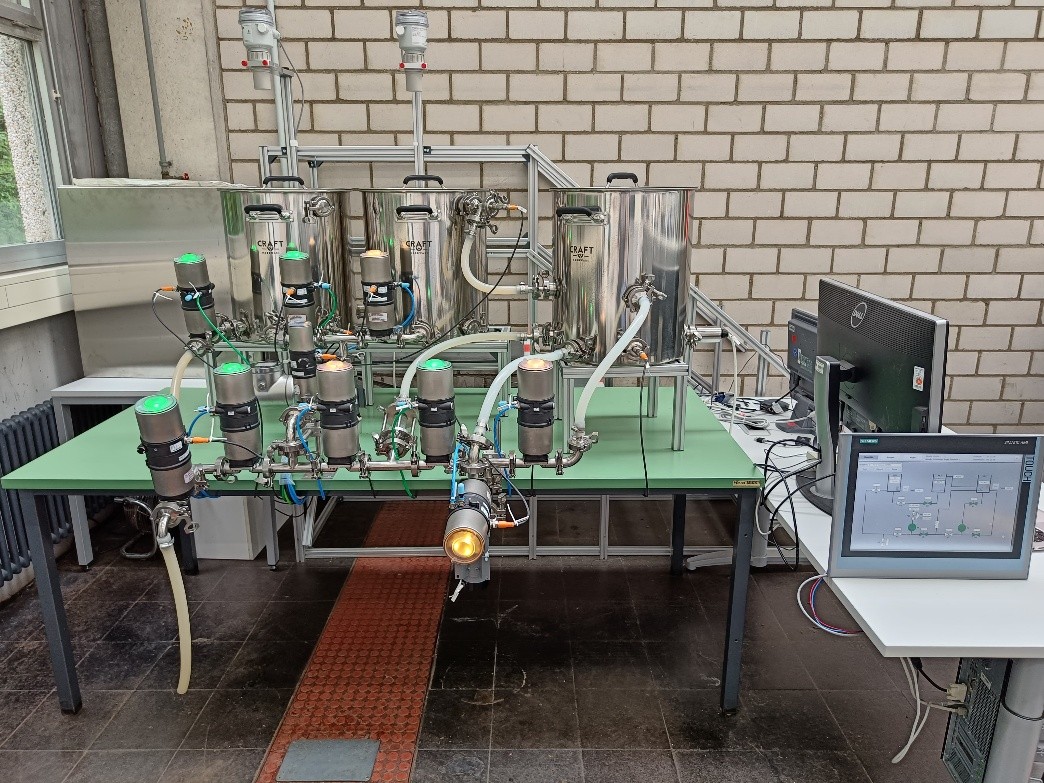
The Learning by Brewing teaching/learning concept combines theoretical training in automation technology with practical application on an experimental brewing system. Through close integration of lectures and laboratory work, students not only acquire technical skills in process control technology, sensor technology, and actuator technology, but also develop their social skills through small group work. A central element is the development, implementation, and validation of a complete automation system. The optional BRAUtomation course also allows for creative, competition-based in-depth study. The concept promotes interdisciplinary thinking, motivates through its high practical relevance, and aims to increase the attractiveness of the automation technology major.
References
[1] Bundesingenieurkammer e. V. (Hrsg.). Das Berufsbild des Ingenieurs - Gemeinsame Eckpunkte der Ingenieurkammern der Länder. 2014.
[2] Institut der deutschen Wirtschaft Köln e. V. (Hrsg.). MINT-Herbstreport 2024. 2024.
[3] Verband der Elektrotechnik Elektronik Informationstechnik (VDE). Arbeitsmarkt 2022 - Elektroingenieurinnen und -ingenieure. 2022.
[4] IHK-Fachkräftereport 2023: Deutsche Industrie- und Handelskammer (DIHK). DIHK Report Fachkräfte 2023/2024. 2023.
[5] Statistisches Bundesamt (Destatis) (2024). Zahl der Hochschulabschlüsse 2023 um 0,7 % gesunken (Pressemitteilung Nr. 349 vom 16.09.2024). 2024.
[6] M. Alarfaj, S.Raja Mohamed, Slim Chtourou, Hesham Enshasy, Aly Aboulnaga, and M. Hassan, "Experience of Project-Based Learning: Challenges, Assessment, and Analysis", Int. J. Eng. Ped., vol. 14, no. 3, pp. pp. 123-139, Apr. 2024. https://doi.org/10.3991/ijep.v14i3.43849 DOI: https://doi.org/10.3991/ijep.v14i3.43849
[7] Pritschow, G. & Konvent für Technikwissenschaften der Union der Deutschen Akademien der Wissenschaften (Hrsg.). Projektarbeiten in der Ingenieurausbildung: Sammlung beispielgebender Projektarbeiten an technischen Universitäten in Deutschland. Fraunhofer-IRB-Verl. 2005.
[8] Statistisches Bundesamt (Destatis). Studierende in Mathematik, Informatik, Naturwissenschaften und Ingenieurwissenschaften 2023/2024. 2024.
[9] Bindel T., Hofmann D. R&I-Fließschema: Übergang von DIN 19227 zu DIN EN 62424. Springer Vieweg Wiesbaden; 2016. ISBN 978-3-658-15559-9. https://doi.org/10.1007/978-3-658-15559-9_3 DOI: https://doi.org/10.1007/978-3-658-15559-9_3
[10] Palmer J. How To Brew: Everything You Need to Know to Brew Great Beer Every Time. Brewers Publications; 2017. ISBN 978-1938469350.
[11] Narziß L., Back W., Gastl M., Zarnkow M. Abriss der Bierbrauerei. Wiley-VCH; 2017. ISBN 978-3-527-34036-1. https://doi.org/10.1002/9783527812820 DOI: https://doi.org/10.1002/9783527812820
[12] Brewers Association. Brewers Association 2025 Beer Style Guidelines. 2025. https://www.brewersassociation.org/edu/brewers-association-beer-style-guidelines/
[13] Wildt J. Forschendes Lernen: Lernen im Prozess der Konstruktion von Wissen. In: Huber L, Hrsg. Forschendes Lernen im Studium. 2009.
[14] Bundesingenieurkammer (BIngK). Ziele der Ingenieurausbildung und deren Einordnung innerhalb des Deutschen Qualifikationsrahmens für lebenslanges Lernen. 2015.
[15] Deutscher Wissenschaftsrat. Empfehlungen für eine zukunftsfähige Ausgestaltung von Studium und Lehre. 2022.
[16] Biggs J, Tang C. Teaching for Quality Learning at University. McGraw-Hill Education; 2011.
Downloads
Details




Funding data
-
Bundesministerium für Bildung und Forschung
Grant numbers 16DHBKI060
License
Copyright (c) 2026 Patrick Rebling, Corinna Eußner, Yannick Rauch, Philipp Nenninger, Nico Link

This work is licensed under a Creative Commons Attribution 4.0 International License.