

Gaze pattern: Investigation of strategies for dealing with indirectly proportional function graphs in a thermodynamic context
Authors
Files
Abstract
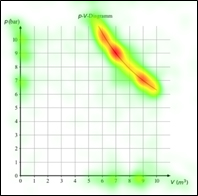
The ability to distinguish mathematical functions is crucial for understanding complex concepts in mathematics and physics. Differentiating graphs of indirectly proportional functions from other power functions poses significant challenges for many students, which is reflected in their strategies. This study examined the gaze behavior of 80 tenth-grade students when identifying isothermal changes of state in p-V diagrams. Using gaze data and retrospective interviews, two primary strategies were identified: a focus on value pairs, where pressure and volume values were compared, and a focus on the graph of function, where the curve's trajectory was analyzed. Students who focused on value pairs exhibited mostly horizontal and vertical gaze movements, while those concentrating on the graph of function demonstrated diagonal saccades. However, many students focusing on the graph of function paid attention to irrelevant aspects, such as the position of the curve, which led to confusion between isothermal and adiabatic changes of state. The results provide insights essential for developing adaptive teaching methods that are aligned with learners' specific strategies and eye movement patterns to improve their understanding of thermodynamic function graphs.
References
[1] Fehlinger, P., Becker-Genschow, S. & Watzka, B. Gaze behavior as a key to revealing strategies for identifying indirectly proportional graphs in thermos. dynamic and mathematical context. Phys. Rev. Phys. Educ. Res. 21. 020129. https://doi.org/10.1103/4pn3-fs4y DOI: https://doi.org/10.1103/4pn3-fs4y
[2] Adila, A. S. D., Sutopo & Wartono (2018). Students' reasoning in analyzing temperature from PV diagram representing unfamiliar thermodynamics process. Journal of Physics Conference, 1097(1), 012012. https://doi.org/10.1088/1742-6596/1097/1/012012 DOI: https://doi.org/10.1088/1742-6596/1097/1/012012
[3] Saepuzaman, D., Sriyansyah, S. P. & Karim, S. (2019). Unpacking Pre-service Physics Teachers' Understanding of the PVT Diagram and the Associated Mathematics. Journal of Physics Conference Series 1204, No. 1, 012032 https://doi.org/10.1088/1742-6596/1204/1/012032 DOI: https://doi.org/10.1088/1742-6596/1204/1/012032
[4] Ostermann, A., Leuders, T. & Nückles, M. (2018). Improving the judgment of task difficulties: prospective teachers' diagnostic competence in the area of functions and graphs. Journal of Mathematics Teacher Education, 21, 579-605. https://doi.org/10.1007/s10857-017-9369-z DOI: https://doi.org/10.1007/s10857-017-9369-z
[5] Fermi, E. (2012). Thermodynamics. Courier Corportion.
[6] Pinker, S. (1990). A theory of graph comprehension. In R. Freedle (Hrsg.), Artifical intelligence and the future of testing (S. 73-126). Erlbaum.
[7] Unema, P. J. A., Pannasch, S., Joos, M. & Velichkovsky, B. M. (2005). Time course of in formation processing during scene perception: The relationship between saccade amplitude and fixation duration. Visual Cognition, 12(3), 473-494. https://doi.org/10.1080/13506280444000409 DOI: https://doi.org/10.1080/13506280444000409
[8] Klein, P., Hahn, L., & Kuhn, J. (2021). Einfluss visueller Hilfen und räumlicher Fähigkeiten auf die graphische Interpretation von Vektorfeldern: Eine Eye-Tracking-Untersuchung. ZfDN, 27, 181-201. https://doi.org/10.1007/s40573-021-00133-2 DOI: https://doi.org/10.1007/s40573-021-00133-2
[9] Kiili, K., Ketamo, H., Koivisto, A., & Finn, E. (2014). Studying the user experience of a tablet based math game. International Journal of Game-Based Learning (IJGBL), 4(1), 60-77. https://doi.org/10.4018/IJGBL.2014010104 DOI: https://doi.org/10.4018/IJGBL.2014010104
[10] Guan, Z., Lee, S., Cuddihy, E., & Ramey, J. (2006, April). The validity of the stimulated retrospective think-aloud method as measured by eye tracking. In Proceedings of the SIGCHI conference on Human Factors in computing systems (pp. 1253-1262). https://doi.org/10.1145/1124772.1124961 DOI: https://doi.org/10.1145/1124772.1124961
[11] Thomaneck, A., Vollstedt, M., & Schindler, M. (2023). Eye-Tracking und Stimulated Recall Interviews zur Strategieanalyse bei der Erfassung der Änderung von Graphen.
[12] Ward, J. H. (1963). Hierarchical grouping to optimize an objective function. Journal of the American Statistical Association, 58 (301), 236-244. https://doi.org/10.1080/01621459.1963.10500845 DOI: https://doi.org/10.1080/01621459.1963.10500845
[13] Kuckartz, U. (2019). Qualitative text analysis: A systematic approach. In G. Kaiser & N. Presmeg (Eds.), Compendium for early career researchers in mathematics education (pp. 181-197). Springer. https://doi.org/10.1007/978-3-030-15636-7_6 DOI: https://doi.org/10.1007/978-3-030-15636-7_8
Downloads
Details




License
Copyright (c) 2025 Paula Fehlinger, Sebastian Becker-Genschow, Bianca Watzka

This work is licensed under a Creative Commons Attribution 4.0 International License.