

Lernen auf Distanz - Teilhabe vor Ort: Telepräsenzsysteme in der medizinischen Lehre
Autor/innen
Dateien
Abstract
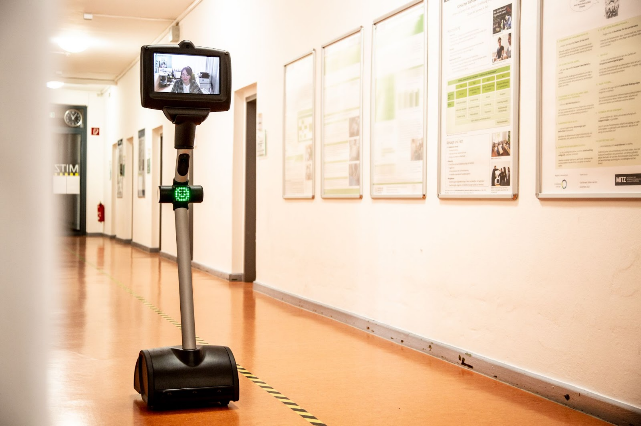
Telepräsenzroboter (TPR) ermöglichen Studierenden eine aktive Teilnahme an der medizinischen Lehre trotz physischer Abwesenheit. Im Vergleich zur reinen Online-Lehre erhöhen sie die soziale Präsenz durch steuerbare Mobilität und Interaktion in Diskussionen und Gruppenarbeiten.
Im Projekt virTUos wurden TPR am Medizinischen Interprofessionellen Trainingszentrum (MITZ) der Medizinischen Fakultät Dresden in Seminaren und Pflichtveranstaltungen eingesetzt. Geschätzt wurden die selbstständige Steuerung sowie der direkte Kontakt zu Lehrenden und Mitstudierenden. Gleichzeitig traten technische Probleme wie instabile WLAN-Verbindungen, eingeschränkte Sichtfelder und Ton-Bild-Verzögerungen auf.
Ergänzend wurde ein Pan-Tilt-Zoom-(PTZ)-Kamerasystem entwickelt, das zwar nicht mobil, aber stabiler und kostengünstiger ist.
Insgesamt fördern Telepräsenzsysteme die Chancengleichheit und eignen sich besonders für praxisnahe Lehrformate. Voraussetzung sind eine zuverlässige Infrastruktur, klare Einweisungen und die aktive Unterstützung durch Lehrende und Studierende. TPR sind damit auch über die medizinische Ausbildung hinaus ein inklusives Instrument.
Literaturhinweise
1] Lörz M, Marczuk A, Zimmer L, Multrus F, Buchholz S. Studying under coronavirus conditions: Students evaluate the first digital semester; 2020. DOI: 10.34878/2020.05.dzhw_brief
[2] Traus A, Höffken K, Thomas S, Mangold K, Schröer W. Stu.diCo. - Studying digitally in times of coronavirus; 2020. DOI: 10.18442/150
[3] Wolff F, Möller J. Telepresence robots in higher education: Findings from a longitudinal study indicate high acceptance. die hochschullehre 2021; 7.
https://doi.org/10.3278/HSL2118W DOI: https://doi.org/10.3278/HSL2118W
[4] Leoste J, Kikkas K, Tammemäe K, Rebane M, Laugasson E, Hakk K. Telepresence Robots in Higher Education - The Current State of Research. In: Lepuschitz W, Merdan M, Koppensteiner G, Balogh R, Obdržálek D, editors. Robotics in Education. Cham: Springer International Publishing; 2022. p. 124-34 (Lecture Notes in Networks and Systems).
https://doi.org/10.1007/978-3-031-12848-6_12 DOI: https://doi.org/10.1007/978-3-031-12848-6_12
[5] Weibel M, Nielsen MKF, Topperzer MK, Hammer NM, Møller SW, Schmiegelow K et al. Back to school with telepresence robot technology: A qualitative pilot study about how telepresence robots help school-aged children and adolescents with cancer to remain socially and academically connected with their school classes during treatment. Nurs Open 2020; 7(4):988-97.
https://doi.org/10.1002/nop2.471 DOI: https://doi.org/10.1002/nop2.471
[6] Ahumada-Newhart V, Olson JS. Going to School on a Robot: Robot and User Interface Design Features That Matter. ACM Trans Comput Hum Interact 2019; 26(4).
https://doi.org/10.1145/3325210 DOI: https://doi.org/10.1145/3325210
[7] Hu J, Reyes Cruz G, Fischer J, Maior HA. Telepresence Robots for Remote Participation in Higher Education. In: Proceedings of the 3rd Annual Meeting of the Symposium on Human-Computer Interaction for Work. New York, NY, USA: ACM; 2024. p. 1-14.
https://doi.org/10.1145/3663384.3663394 DOI: https://doi.org/10.1145/3663384.3663394
[8] Trittin R, Blumenthal S. On the benefits of telepresence robots in teacher training [12MB]. k:ON - Cologne Online Journal for Teacher Training 2024; 8. DOI: 10.18716/ojs/kON/2024.14
[9] Leoste J, Virkus S, Talisainen A, Tammemäe K, Kangur K, Petriashvili I. Higher education personnel's perceptions about telepresence robots. Front Robot AI 2022; 9:976836.
https://doi.org/10.3389/frobt.2022.976836 DOI: https://doi.org/10.3389/frobt.2022.976836
[10] Röhle A. Practical teaching is going digital - are we all on board? Implementation and further development of digital teaching at the Medical Interprofessional Training Center (MITZ) with a focus on equal opportunities. Equal Opportunities - Perspectives for Higher Education 2022; Volume 1. Available from: URL: https://nbn-resolving.de/urn:nbn:de:bsz:15-qucosa2-829635 [cited 2025 Sep 23].
https://doi.org/10.25369/ll.v2i1.45
[11] Röhle A, Bibrack E. Digital and hybrid teaching in medical education using the example of the Medical Interprofessional Training Center MITZ: Impulses and development potential. LL 2022; 2(1).
https://doi.org/10.25369/ll.v2i1.45 DOI: https://doi.org/10.25369/ll.v2i1.45
[12] Willemer M-C, Röhle A. MITZ makes it possible: Participation in practical teaching through the use of telepresence robots at the Medical Interprofessional Training Center (MITZ) [German Medical Science GMS Publishing House]. Joint Annual Conference of the Society for Medical Education (GMA) and the Working Group for the Further Development of Teaching in Dentistry (AKWLZ) 2022. DOI: 10.3205/22gma049
[13] Odenbach S, Wermann C, Willemer M-C, Röhle A, Mailach J. Hybrid teaching concepts with telepresence robots. (From practice). Available from: URL: https://www.e-teaching.org/praxis/erfahrungsberichte/hybride-lehrkonzepte-mit-telepraesenzrobotern [cited 2025 Sep 23].
Downloads
Angaben zum Artikel




Lizenz
Copyright (c) 2025 M.-C. Willemer, J. Mailach, D. Pretze, Ingo Röder

Dieses Werk steht unter der Lizenz Creative Commons Namensnennung 4.0 International.