

DikoLint: Design, communication, and interculturality in virtual learning settings – lessons learned from a subproject of virTUos
Authors
Files
Abstract
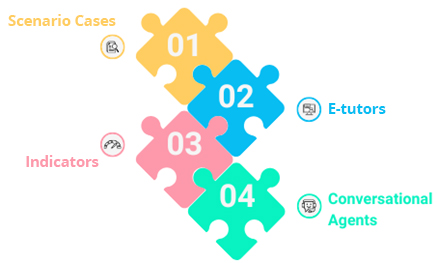
The DikoLint subproject, embedded in the STiL-funded joint project virTUos at the Technical University of Dresden, aimed at the systematic further development of Virtual Collaborative Learning (VCL) in international teaching contexts. The focus was on the didactic modeling of complex case scenarios, the intercultural qualification of student e-tutors in tandem structures, and the development of feedback and intervention indicators for proactive learning support. The project was supplemented by the integration of digital tools such as conversational agents and gamification elements. The results show a high transfer potential to other virtual, interdisciplinary, and international teaching formats, especially COIL settings. DikoLint thus makes a substantial contribution to the strategic further development of the VCL framework and supports universities in the professional, sustainable, and internationally compatible design of digital learning offerings.
References
[1] Bates, A. (2015). Teaching in a Digital Age. IRL @ UMSL. https://irl.umsl.edu/oer/6
[2] Ware, P. (2013). Teaching comments: intercultural communication skills in the digital age. Intercultural Education, 24(4), 315-326. https://doi.org/10.1080/14675986.2013.809249 DOI: https://doi.org/10.1080/14675986.2013.809249
[3] Tawileh, W., Bukvova, H. & Schoop, E. (2012). Virtual Collaborative learning. In IGI Global eBooks (S. 380-410). https://doi.org/10.4018/978-1-4666-2515-0.ch014 DOI: https://doi.org/10.4018/978-1-4666-2515-0.ch014
[4] Altmann, M., Langesee, L.-M., Jantos, A., Cool, S., & Müller, C. (2024). Design Dimensions of Virtual Collaborative Learning - Synthesizing Iterative Research. In Handbuch E-Learning (106. Erg.-Lfg. Februar 2024), S. 99-119.
[5] Berger, V., Langesee, L.-M., Altmann, M., & Schmidt, S. (2023). Lessons Learned aus der Iterativen Weiterentwicklung von Kollaborativer Online Lehre. In T. Köhler, E. Schoop, N. Kahnwald, & R. Sonntag (Eds.), GeNeMe 2022 Proceedings (pp. 98-103). TUDpress. https://doi.org/10.25368/2023.15 DOI: https://doi.org/10.25368/2023.63
[6] https://patterns.im.wiwi.tu-dresden.de/start
[7] Volkmann, N. & Schmidt, S. (2022). Design pattern for conversational agents handling data-driven requests. Workshop Gemeinschaften in Neuen Medien (GeNeMe) 2022. TUDpress - Verlag der Wissenschaften https://doi.org/10.25368/2023.72 DOI: https://doi.org/10.25368/2023.72
[8] Altmann, M. & Arnold, M. (2024). Designing formative feedback in collaborative online international learning. Human Systems Management, 1-18. https://doi.org/10.3233/HSM-230100 DOI: https://doi.org/10.3233/HSM-230100
[9] Jantos, A., Kilz, L., & Krohn, M. (2024). "Führerschein für Digitalkompetenzen": Vorstellung und Evaluation eines interdisziplinären Virtual Collaborative Learnings. Zeitschrift für Hochschulentwicklung, 19(2), 159-180. https://doi.org/10.21240/zfhe/19-2/08 DOI: https://doi.org/10.21240/zfhe/19-2/08
Downloads
Details




License
Copyright (c) 2026 Lisa-Marie Langesee

This work is licensed under a Creative Commons Attribution 4.0 International License.