

Programming for the Humanities and Social Sciences
Authors
Files
Abstract
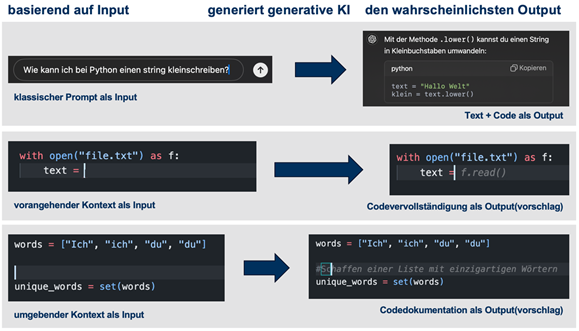
The ongoing digitization in the humanities and social sciences (HSS) enables and requires the use of new, particularly quantitative, analysis methods. Programming skills give researchers the most flexible way to handle data. However, these are not typically taught in HSS degree programs, and existing teaching/learning materials usually require prior technical knowledge. For this reason, the virTUos subproject ExDiMed has developed low-threshold, modular self-learning materials for teaching coding skills in the programming language Python, which are specifically tailored to the needs and requirements of HSS students. The content, in the form of interactive Jupyter Notebooks, is available to learners and teachers as OER and has been successfully tested and refined at TU Dresden over six semesters in a flipped classroom seminar. With the advent of generative AI, the course has been expanded in an exploratory manner to sensitize students to the constructive use of AI in coding. Our evaluation shows that teaching basic programming skills has become more relevant in the age of AI, as the latter can only act as a catalyst for coding practice if students already have the basics. Our teaching/learning concept is now firmly established in the Master's program in Digital Humanities at TU Dresden and will continue to be developed even after the project ends.
References
[1] L. Beck und A. Chizhik, "Cooperative learning instructional methods for CS1: Design, implementation, and evaluation", ACM Trans. Comput. Educ., Bd. 13, Nr. 3, S. 10:1-10:21, Aug. 2013, https://doi.org/10.1145/2492686 DOI: https://doi.org/10.1145/2492686
[2] H. Snee, C. Hine, Y. Morey, S. Roberts, und H. Watson, "Digital Methods as Mainstream Methodology: An Introduction", in Digital Methods for Social Science: An Interdisciplinary Guide to Research Innovation, H. Snee, C. Hine, Y. Morey, S. Roberts, und H. Watson, Hrsg., London: Palgrave Macmillan UK, 2016, S. 1-11. https://doi.org/10.1057/9781137453662_1 DOI: https://doi.org/10.1057/9781137453662_1
[3] Deutsche Forschungsgemeinschaft, "Digitaler Wandel in den Wissenschaften", Okt. 2020, doi: 10.5281/ZENODO.4191345.
[4] F. Jannidis, H. Kohle, und M. Rehbein, Hrsg., Digital Humanities. Eine Einführung. Stuttgart: Metzler, 2017. https://doi.org/10.1007/978-3-476-05446-3 DOI: https://doi.org/10.1007/978-3-476-05446-3
[5] Y. Frommherz, A. J. Matz, und S. Meier-Vieracker, "KI-gestütztes Programmierenlernen - Erprobung und Erfahrungen eines Lehr-Lernkonzepts". Zugegriffen: 14. August 2025. [Online]. Verfügbar unter: https://fis.uni-bamberg.de/handle/uniba/107576 https://doi.org/10.20378/irb-107576 DOI: https://doi.org/10.20378/irb-107576
[6] G. Punziano, "Adaptive Epistemology: Embracing Generative AI as a Paradigm Shift in Social Science", Societies, Bd. 15, Nr. 7, S. 205, Juli 2025, https://doi.org/10.3390/soc15070205 DOI: https://doi.org/10.3390/soc15070205
[7] S. Schiller-Stoff, L. E. Münzer, C. Dittmann, und S. Sagadin, "Der Einfluss von AI-Pair-Programmers auf die Digital Humanities: Potentiale und Limitationen", in Book of Abstracts DHd 2025, Bielefeld, 2025. doi: https://doi.org/10.5281/zenodo.14887461.
[8] Y. Frommherz und J. Langenhorst, "Digitale Kompetenzen für Geistes- und Sozialwissenschaftler:innen. Vorzüge eines Blended Learning-Formats für die Vermittlung von Programmierkenntnissen.", Lessons Learn., Bd. 2, Nr. 1, Juli 2022, https://doi.org/10.25369/ll.v2i1.37 DOI: https://doi.org/10.25369/ll.v2i1.37
[9] T. Koulouri, S. Lauria, und R. D. Macredie, "Teaching Introductory Programming: A Quantitative Evaluation of Different Approaches", ACM Trans. Comput. Educ., Bd. 14, Nr. 4, S. 1-28, Feb. 2015, https://doi.org/10.1145/2662412 DOI: https://doi.org/10.1145/2662412
[10] S. Seufert und P. Mayr, Fachlexikon e-lerning: Wegweiser durch das e-Vokabular. in managerSeminare. Bonn: ManagerSeminare May, 2002.
[11] E. Schoop, H. Bukvova, und C. Lieske, "Blended-Learning arrangements for higher education in the changing knowledge society", in Proceedings of the International Conference on Current Issues in Management of Business and Society Development, Riga, Lat., Dresden: TU Dresden, 2010. [Online]. Verfügbar unter: https://nbn-resolving.org/urn:nbn:de:bsz:14-qucosa-26183
[12] M. Kerres, Mediendidaktik: Konzeption und Entwicklung mediengestützter Lernangebote. München: OLDENBOURG WISSENSCHAFTSVERLAG, 2013. https://doi.org/10.1524/9783486736038 DOI: https://doi.org/10.1524/9783486736038
[13] G. Braught, T. Wahls, und L. M. Eby, "The Case for Pair Programming in the Computer Science Classroom", ACM Trans. Comput. Educ., Bd. 11, Nr. 1, S. 2:1-2:21, Feb. 2011, https://doi.org/10.1145/1921607.1921609 DOI: https://doi.org/10.1145/1921607.1921609
[14] S. Meier-Vieracker, ",LIEBE SOPHIE' - ADRESSIERUNG UND INVOLVIERUNG IN INSTAGRAM-KOMMENTAREN AM BEISPIEL DES PROJEKTES @ICHBINSOPHIESCHOLL", Dez. 2023, https://doi.org/10.35542/osf.io/ve3zr DOI: https://doi.org/10.35542/osf.io/ve3zr
[15] A. Ziegler u. a., "Productivity assessment of neural code completion", in Proceedings of the 6th ACM SIGPLAN International Symposium on Machine Programming, San Diego CA USA: ACM, Juni 2022, S. 21-29. https://doi.org/10.1145/3520312.3534864 DOI: https://doi.org/10.1145/3520312.3534864
Downloads
Details




License
Copyright (c) 2026 Yannick Frommherz, Simon Meier-Vieracker, Anne Josephine Matz

This work is licensed under a Creative Commons Attribution 4.0 International License.